
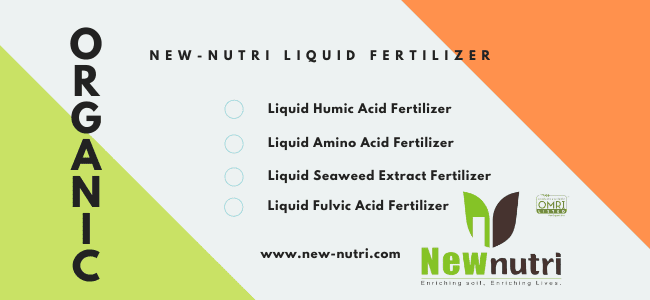
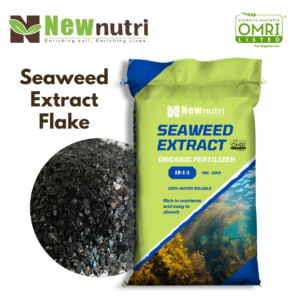
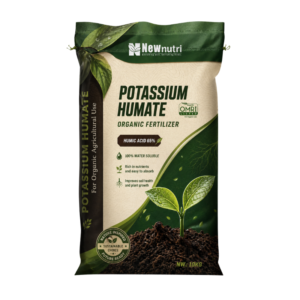
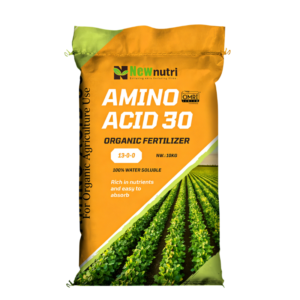
When crops are actively growing in the mid- to late part of the season, they demand greater quantities of nutrients on a daily basis. Immobile nutrients applied to the soil surface can face difficulty getting down to the roots where they’ll be taken up. When looking at in-season corrective measures, foliar fertilization has been growing as the go-to option for growers to supply those nutrients. New-nutri has Humic Acid Foliar Fertilizer, Potassium Humate, Fulvic Acid, Amino Acid Foliar Fertilizer and Seaweed Extract.
While foliar applications are a helpful management tool for in-season applications, there is a risk for crop damage if applied incorrectly. Here’s a look at the how-to and limitations of foliar fertilization.
Tips for Foliar Application
1. Determine if you really need the application
Find a tool to help determine whether or not a nutrient is going to increase yield when applied. Take soil or tissue samples to test for nutrient deficiencies before or at the time of planting. Plant tissue analysis has filled the void left by soil tests in-season, but these results are highly subjective. See our tips for more effective tissue sampling for more information.
Keep in mind the relative mobility of nutrients in the soil. Apply mobile nutrients to the soil surface. With immobile nutrients like P, K, Zn, Fe, Cu, Mn and amino acid microelement, apply at or near planting to allow for easy uptake by plant roots. For micronutrients, use a starter fertilizer package at planting.
2. Keep rates low to prevent leaf damage
The major risk associated with foliar applications comes from damaging the plant itself. Make sure the rate you’re applying at is not causing more harm than good. Increasing carrier volume will not decrease the risk of foliar damage.
For example, you can check the application data of humate fertilizer and humic acid foliar fertilizer on our website.
3. Look at the compatibility of your mix.
Pay attention to the mixes you’re putting together to make sure that you’re not causing excessive foliar damage. We see this a lot when we mix high nitrogen sources with fungicides, resulting in leaf burning that can reduce yield. The other thing to look out for is mixing with adjuvants. Typically, we see two classes recommended for foliar application. One is a non-ionic surfactant or an acidifying agent to help distribute that spray over the leaf area and help potentially penetrate the leaf.
Foliar fertilizer application guidelines
When crops are actively growing in the mid- to late part of the season, they demand greater quantities of nutrients on a daily basis. Immobile nutrients applied to the soil surface can face difficulty getting down to the roots where they’ll be taken up. When looking at in-season corrective measures, foliar fertilization has been growing […]

Product Portfolio
Explore Our Solutions

Keep Reading
Related Articles
Is humic acid fertilizer better than traditional chemical fertilizer
New-Nutri produces many kinds of Humic Acid Fertilizers, such as humic acid soil conditional granules, potassium humate, fulvic acid, liquid humic acid fertilizer, humic acid binds to amino acids, humic acid binds to seaweed extract, etc. Humic acid fertilizers and traditional chemical fertilizers serve different purposes, so comparing them depends on the context of crop […]

Effective combination and function of organic matter and lime
Soil health is the foundation of agricultural production, and the strategic addition of organic matter and lime can significantly improve soil fertility and structure. Let’s explore how these two key amendments can work together to improve soil health and support sustainable agricultural practices. Effects of organic matter on soil health Provide nutrients: Organic matter is […]

What Plants Are Humic Acid Liquid Fertilizers Suitable For?
What Plants Are Humic Acid Liquid Fertilizers Suitable For? The answer is: Almost all plants. Humic acid liquid fertilizer combined with nitrogen, phosphorus, potassium and other elements has the functions of improving soil, stimulating crop growth, improving the quality of agricultural products, and synergizing fertilizers. It can provide long-term nutrition to plants and land. Here […]
Start a Supply Conversation
Get Specifications & Pricing Directly from the Source.
Share your product interest, target volume and market. Our technical team will respond with tailored specifications, packaging options and competitive pricing.
-
Response
Within 24 hours
-
Minimum
Flexible MOQ
-
Samples
Available on request
Request Product Information
Tell us what you need and we'll follow up with full specifications and pricing.
Leave a Reply