
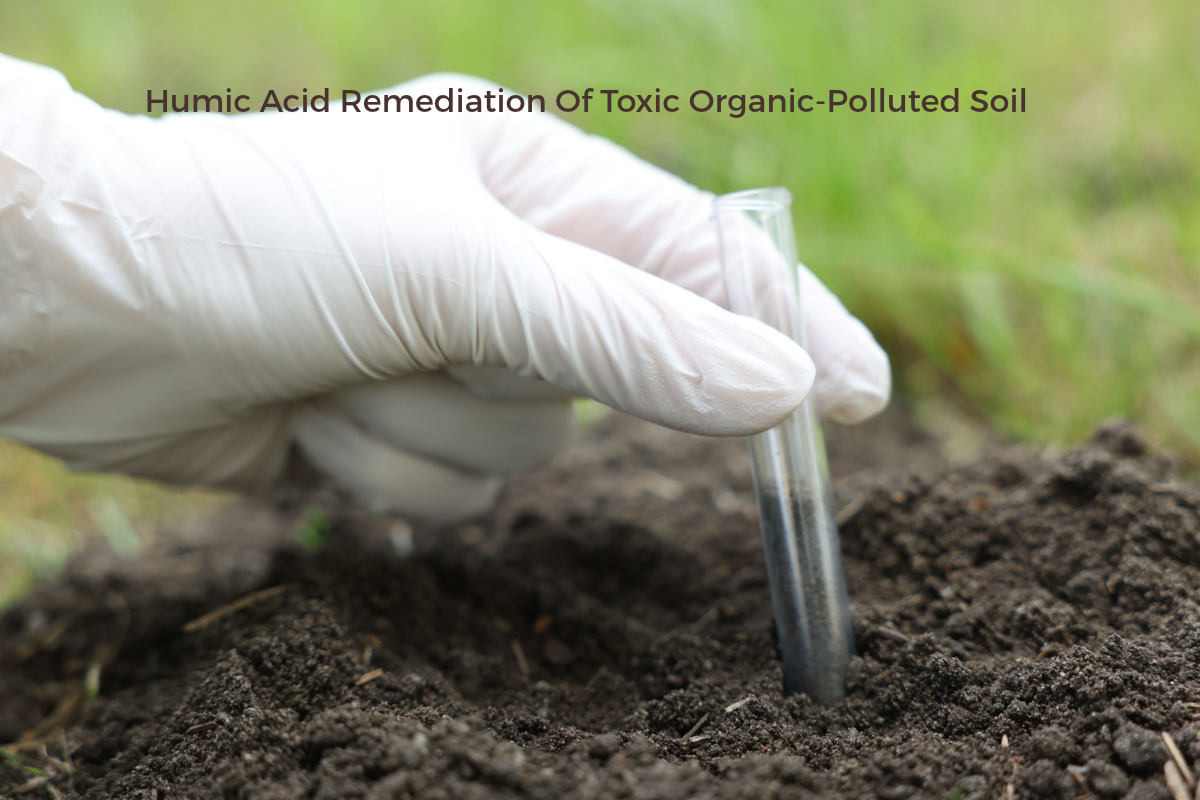
Organic pollutants that enter the soil are divided into natural organic pollutants and synthetic organic pollutants. The former is mainly produced during chemical reactions or biological metabolism under natural conditions, and the latter is mainly due to human production and life activities.
Organic pollutants in the soil will have a harmful effect on the ecological environment, not only affecting the growth and development of crops, reducing crop quality and yield, but also, organic matter can be enriched by plants and enter the human body through the food chain, seriously threatening human health.

Today we are going to talk about how humic acid repairs soil contaminated with toxic organic matter.
1. Humic acid adsorption and precipitation of organic pollutants in soil
Humic acid is mainly combined with organic pollutants through physical adsorption, distribution, hydrogen bonding, covalent bonding, etc. to reduce the bioavailability and content of toxic organic pollutants in the soil. The organic-inorganic composite colloid formed by humic acid and soil further enhances the adsorption of organic matter. The adsorption properties of humic acid to ions can make the cations of organic matter adsorb tightly around the humic acid molecules, reducing the migration of organic pollutants in the soil.
The molecular weight of humic acid directly affects the adsorption of organic pollutants. As the molecular weight of humic acid increases, the adsorption of hydrophobic organic matter increases. At the same time, humic acids can fix and precipitate organic pollutants well. This effect is more obvious in water bodies, and can well reduce water pollution caused by organic pollutants.
2. Redox effect of humic acid on organic pollutants in soil
Humic acid contains a variety of functional groups, some of which have reversible redox and ion exchange functions, which can reduce the content of organic matter in the soil. The mechanism is mainly in the following two ways:
(1) Humic acid can transfer electrons from reduced compounds to aromatic compounds and other toxic organic pollutants, and degrade these organic pollutants. In this process, humic acid acts as an electron transmitter.
(2) Humic acid accepts the electrons provided by toxic organic pollutants and oxidizes these organic pollutants. In this process, humic acid acts as an electron acceptor. This method can support the growth of bacteria and form a new type of bacterial anaerobic breathing -Breathing of humic acids. Relevant research shows that the components that play the role of humic acid respiration are mainly quinone components in humic acid, which play the role of the final electron acceptor in the process of oxidative degradation of organic matter.
(3) Humic acid promotes the degradation of organic matter by soil microorganisms. Humic acid is an organic substance that can provide nutrients for microorganisms in the soil. Humic acid can improve soil structure, reduce soil bulk density, increase soil porosity and permeability, adjust soil pH, and reduce soil salt, thereby providing a very good living environment for microorganisms, allowing microorganisms to multiply and promote degradation of organic matter in the soil. At the same time, humic acid can increase the activity of oxidase and accelerate the degradation of organic pollutants.


Leave a Reply